
Category: Secure Software Development. Tags: secure-sdlc, devsecops, application-security.
A useful review should test whether security controls actually shape delivery decisions
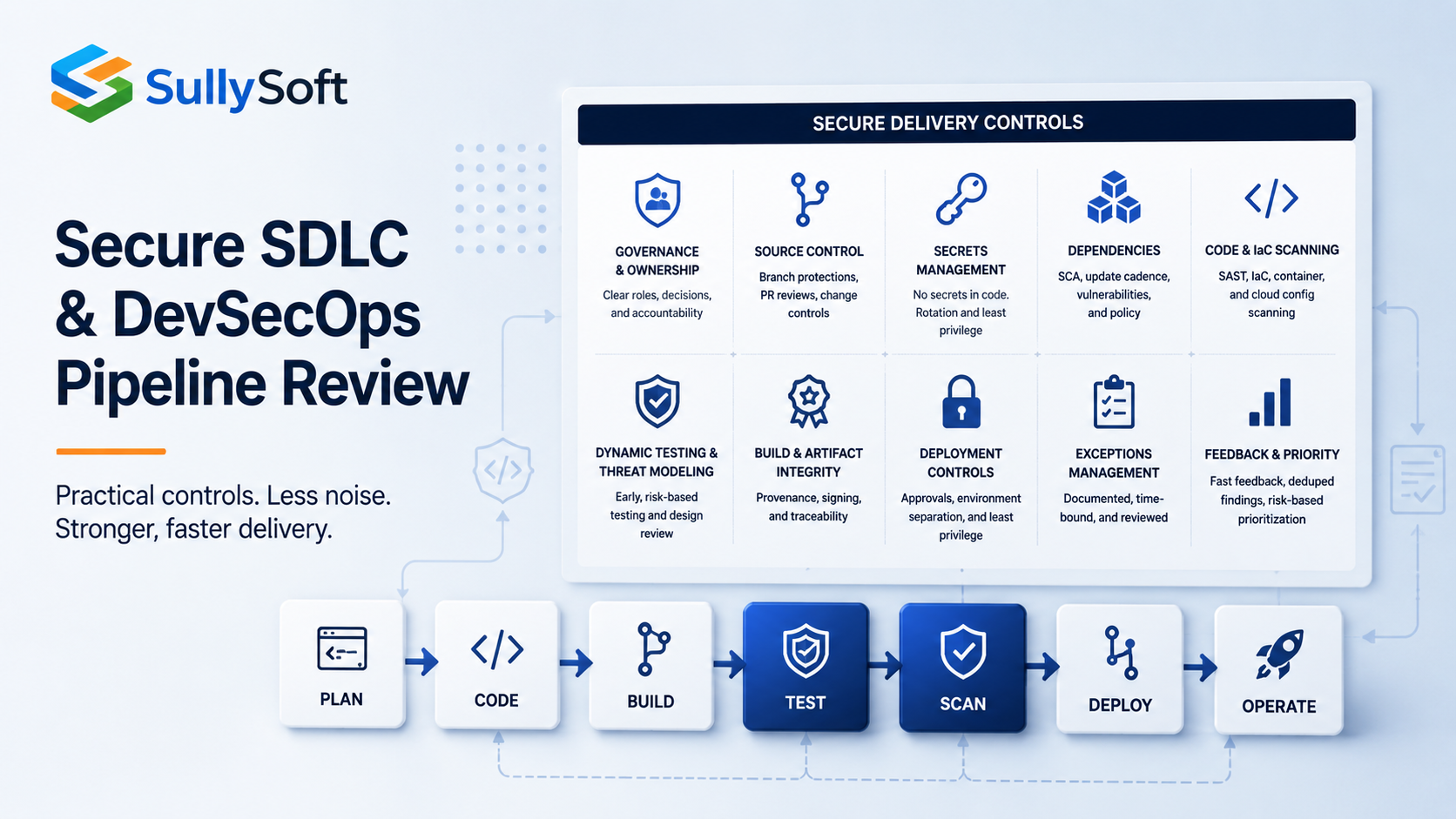
A Secure SDLC and DevSecOps pipeline review should examine whether governance, branch controls, secrets management, dependency checks, infrastructure scanning, artifact integrity, and deployment approvals are working together in a way that developers can actually live with. The review is not just about which scanners are present. It is about whether the delivery pipeline reduces avoidable risk without turning remediation into background noise.
Who this review is for
This article is for software teams, technical leads, founders, and engineering organizations that want to improve delivery security without relying on a vendor-specific checklist. It is especially relevant when security findings are fragmented across tools, pull request controls are inconsistent, or deployment pipelines have grown faster than the governance around them.
Governance and ownership come first
The first question is who owns secure delivery outcomes. A review should identify who can define security requirements, approve exceptions, tune tooling, and decide whether a pipeline gate blocks or warns. If those decisions are scattered informally across platform engineers, developers, and outside advisors, the review should call that out.
Without ownership, tooling becomes a collection of alerts instead of a delivery control system.
Review branching, pull request, and change control basics
Branch protections and pull request rules are still foundational. A practical review should confirm whether protected branches exist, whether reviews are enforced, whether status checks are required, and whether force pushes or direct merges to sensitive branches are limited appropriately.
This is not glamorous work, but weak repository controls can undermine every downstream security check.
Secrets management deserves a dedicated section
The review should examine where secrets live, how they are injected, how rotation works, and whether credentials leak into repositories, build logs, IaC files, or shared configuration. It should also identify whether emergency credentials, long-lived tokens, or environment-specific secrets are handled differently from the desired standard.
I have yet to review a team’s software delivery process and not find secrets exposed in their code repositories, configuration files, or build logs.
If you have followed cybersecurity headlines over the past few years, you know how frequently exposed credentials lead to major corporate breaches. In fact, secret leakage has become so rampant that platforms like GitHub had to build automated detection tools to continuously scan code and alert repository owners before attackers can exploit them.
Dependency management and software composition analysis need policy, not just tooling
A review should look at dependency update cadence, approval practices, lockfile discipline, repository trust, and how the team handles vulnerable packages and transitive dependencies. Software composition analysis is useful, but only if findings are actionable and tied to ownership.
The review should also identify whether dependency findings are deduplicated and prioritized or simply added to a growing noise pile.
Static analysis, IaC scanning, and container scanning should match the stack
Teams often enable several scanners but do not align them to the code paths and infrastructure that matter. A review should confirm whether:
- SAST is relevant to the languages in use.
- IaC scanning covers the actual infrastructure definitions being deployed.
- Container scanning fits the image build and promotion flow.
- Cloud configuration scanning connects to the deployed environment rather than only to templates.
The goal is coverage with useful signal, not maximal scanner count.
Dynamic testing and threat modeling still matter
Pipeline tooling alone does not replace design review. A useful Secure SDLC review should ask how threat modeling is done for meaningful changes, how externally reachable applications are tested dynamically, and whether security requirements are defined early enough to shape architecture rather than just generate tickets later.
This is particularly important for authentication flows, privileged workflows, data handling paths, and externally exposed integrations.
Build provenance and artifact integrity should be visible
A modern pipeline review should examine how artifacts are built, promoted, stored, and verified. Questions include whether build sources are trustworthy, whether artifacts are tamper-evident, whether promotions happen from approved sources, and whether the organization can trace what code version produced what deployment artifact.
The review should also note whether artifact retention and release evidence support future investigation.
Deployment approvals and environment separation should reflect risk
Not every environment needs the same gate, but a review should confirm that production changes, privileged infrastructure changes, and sensitive application updates receive appropriate approval and traceability. It should also examine environment separation, secrets boundaries, and whether lower environments are being used in ways that quietly expand risk.
This is where many teams discover that convenience shortcuts have become part of the default release path.
Exception handling should be structured and reviewable
Some findings will not be fixed immediately. That is normal. The review should examine how exceptions are requested, who approves them, whether compensating controls are documented, and when the exception is revisited.
If exceptions live only in chat threads, tribal memory, or stale tickets, they are not really controlled.
Developer feedback speed and finding deduplication matter more than raw scanner volume
If findings arrive too late, developers ignore them. If the same issue appears in five tools, the team stops trusting the signal. A strong review should evaluate how quickly feedback reaches developers, whether findings are deduplicated, and whether the reporting model encourages remediation rather than scanner activity.
Good metrics often focus on time to remediate meaningful findings, backlog age by risk band, exception review cadence, and recurring weakness patterns. Poor metrics focus only on how many scans ran.
Recommended next step
Use the review to identify the small number of governance, workflow, and control changes that improve the delivery pipeline without making it harder to ship responsibly. The goal is a pipeline that developers can follow and leadership can trust.
Relevant SullySoft CTA
If you need a scoped review of your secure delivery controls, pipeline checkpoints, and remediation workflow, start with the Secure SDLC and DevSecOps Pipeline Review.
Sources and references
About the author

Mike Sullivan
Mike Sullivan leads SullySoft engagements across cybersecurity, cloud architecture, automation, and secure software delivery.
Relevant next step
Move from article advice to a scoped recommendation
Use this article as a starting point, then map the recommendations to your environment, constraints, and priorities.